 STRANGE FRUITShop the archive
The Root · A Strange Fruit series documentary · 1921 · Tulsa, Oklahoma
The Root: Greenwood, 1921
They called it Black Wall Street. In 1906 O.W. Gurley bought forty acres north of the Frisco tracks and mapped out a neighborhood. By 1921 Greenwood had its own hotels, theaters, doctors and newspapers. Then, on the night of May 31, a newspaper headline put a white mob outside the Tulsa courthouse, and by the afternoon of June 1, thirty-five city blocks were gone. This is the true story beneath Dream Land: what happened, how Greenwood rebuilt, how a highway finished what the fire could not, and the search for the missing that is still going on.
- Collection
- The Root
- Format
- Documentary
- Runtime
- 9:14
- Year
- 1921
- Setting
- Tulsa, Oklahoma
Images from the episode
The visual archive
Select a frame to look closer.
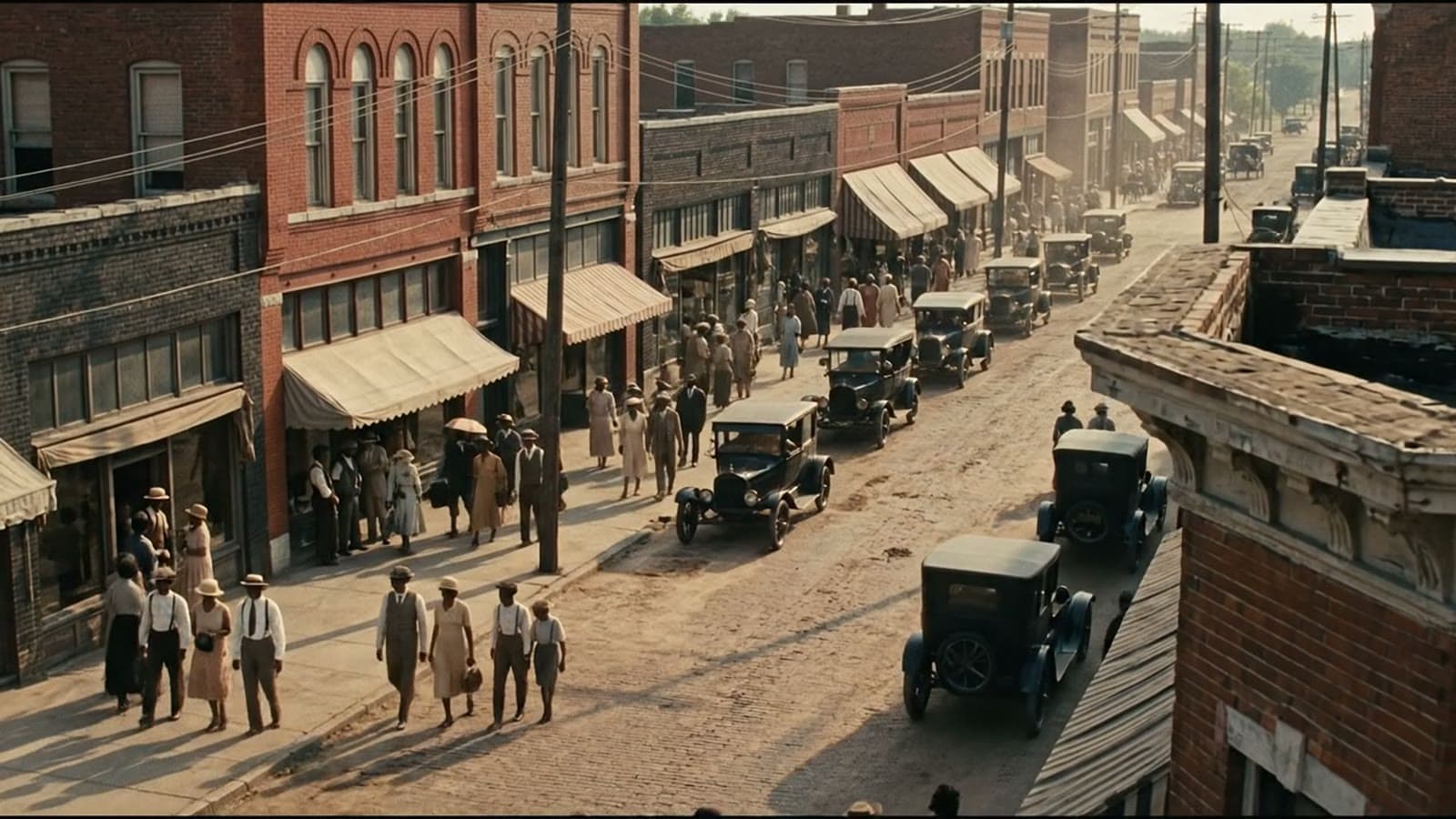
Greenwood Avenue, 1921.
Why it matters
The fire did not kill Greenwood.
Greenwood was built by Black Tulsans who were shut out of downtown by segregation, so they built their own downtown across the Frisco tracks. When the mob burned it, the city tried to stop it from being rebuilt. A lawyer named B.C. Franklin practiced law from a tent and won.
By 1942 the district had 242 Black-owned businesses. What finally emptied it was slower: urban renewal and an interstate. I-244 still runs over Greenwood Avenue today.
Every number in this film is sourced. Where the record is disputed, such as the death toll or the airplanes, the film says so.
Production notes
Narrated by the Strange Fruit narrator, Zephyr, and hosted by Dutch Jackson.
Archive photographs courtesy of the Library of Congress (American National Red Cross and NAACP collections).
Reconstructed scenes were made with generative AI. No real person’s face was generated; real people appear only in archive photographs and name cards.
Content advisory
A documentary about the 1921 Tulsa Race Massacre: racial violence, fire and death, described and shown through reconstructions and archive photographs.
The record
A timeline, with sources
The dates behind the film, each linked to where it comes from.
Historical context · The episode itself is a work of fiction.
May 31, 1921
The Tribune headline
After Dick Rowland is arrested over an incident in the Drexel Building elevator, the Tulsa Tribune runs “Nab Negro for Attacking Girl in an Elevator.” He is never prosecuted.
Explore the source · Tulsa WorldJune 1, 1921
Greenwood burns
About 35 city blocks are destroyed and around 10,000 Black residents are left homeless. Officially 36 died; historians estimate up to 300.
Explore the source · Oklahoma Commission report, 2001Sept 1, 1921
The ordinance falls
A court strikes down the fire ordinance that would have blocked rebuilding. B.C. Franklin was among the lawyers who fought it.
Explore the source · Oklahoma House Resolution 10401967
The expressway
Urban renewal and the Crosstown Expressway cut across the 100 block of North Greenwood. I-244 still runs over the district.
Explore the source · SmithsonianJan 2025
The Justice Department
The DOJ calls the massacre a coordinated, military-style attack and says no one is left to prosecute.
Explore the source · U.S. Department of Justice2026
The search
The excavation at Oaklawn Cemetery enters its sixth season. Two victims have been identified by name: C.L. Daniel and James Goings.
Explore the source · City of Tulsa
The archive is still growing
More from Greenwood, 1921 is coming.
Books, scripts, artwork, and immersive editions will appear here as this story’s archive expands.